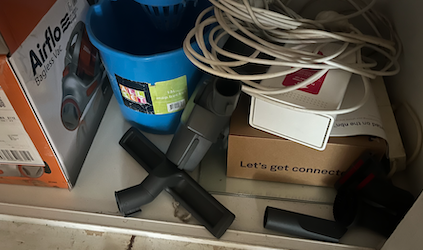
Vacuum cleaner attachments are essential for increasing efficiency, versatility, and precision, allowing a single machine to tackle varied surfaces and hard-to-reach areas. They eliminate the need for multiple cleaning devices, reduce cleaning time by up to half, and prevent injury by enabling the cleaning of high or tight spaces without strain.
So, with that in mind, we can create one robot and a series of attachments to achieve specific tasks.
Active and Passive Attachments
Think about these questions and answer them in your work book:
- The Reach Challenge: If your robot needs to move an object that is 10cm away from its “nose,” why is it better to build an extension rather than just driving the whole robot closer?
- Active vs. Passive: Can you think of a task where the robot can move an object without using a motor (a “passive” attachment)? When would you absolutely need a motor (an “active” attachment)?
- Balance & Gravity: If we build a long, heavy arm onto the very front of the robot, what might happen when the robot tries to drive or turn? How can we fix that?
- The “Pit Stop” Factor: If you had to switch your robot from a “delivery” task to a “lifting” task in under 30 seconds, how should you design your attachments to make them easy to swap?
- Gearing Up: If your robot needs to lift a very heavy load, should the attachment move fast or slow? Why does adding gears help with “heavy lifting”?
You might want to look at pin-less attachments. These are modules that simply drop onto the robot frame without using black or beige pins, making transitions between challenges much faster during a “mission.”
See these videos: