AIT L3
Skill 1 – Creating your plot
Your Task:
In your workbook, write a brief plot summary based on your choice from the brainstorm, and choose a title:
- The protagonist must actively fight for something, not just react to events. Define what they want most and what they are willing to do to get it.
- Give the character a specific “wound” (backstory pain) or a “fatal flaw” that hinders them
- Start with a central “What If?” question to define the inciting incident and focus the plot on answering that question.
- A short story generally focuses on one or two main characters and a single, central conflict.
- Begin as close to the climax or the central problem as possible.
- Generally, stories follow a 6-part structure: Exposition (background), Inciting Incident, Rising Action, Crisis (the tough decision), Climax (showdown), and swift Resolution.
Examples to get you thinking:
Example 1 – ‘Gus is Gone!’
The protagonist, Gus, who just moved into the neighbourhood, is knocking on his neighbours’ doors to introduce himself. He is kidnapped by a dodgy neighbour and locked inside their house after stealing the key to the door, he manages to escape in the end.
Example 2 – ‘Joe’
The story follows the main character, Joe. He can barely do his schoolwork and is frustrated. 1 day he finds a strange glowing object on his desk. When he touches it, he gets superpowers. Suddenly, Joe can run really fast, lift heavy things, and do amazing things. With his new powers, he finishes all his tests and homework quickly. In the end, Joe becomes a superhero and uses his powers to help beat bad guys and make the world a better place. In the end he becomes famous and everyone loves him.
AIT L3
Skill 2 – Character description
Your Task:
In your workbook, write a brief personal background and description for your protagonist, based on your choices from the brainstorm. This will be used in your prompt to create the image.
- Define the physical characteristics of your character
- The protagonist must actively fight for something, not just react to events.
- Define what they want most and what they are willing to do to get it.
- Give the character a specific “wound” (backstory pain) or a “fatal flaw” that hinders them
Examples to get you thinking:
Example 1 – ‘Gus is Gone!’
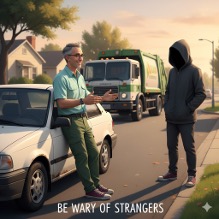
Gus is a 48 year old male, who has grey hair and glasses. He has blue eyes, an aqua shirt and forest green pants. He is a nice person who doesn’t have many friends, so is always talking to strangers. In this story, the lesson learned is that you should be wary when talking to strangers. Gus has maroon shoes and a small analogue watch with a maroon dial. Gus works as a rubbish truck driver, as he didn’t complete high school. He still drives his first car, a 30-year-old Hyundai Excel.
Example 2 – ‘Joe’
Joe is a young Indian boy who lived with his family in India. His family is loving and caring, and they always support him. Joe moved to Australia with his parents to find better opportunities. He is shy and quiet, especially at school, because everything feels new and different. He wears glasses and is skinny. Despite feeling nervous, Joe dreams of being brave and strong. 1 day he finds a glowing object that gives him superpowers, which changes his life forever.
AIT L3
Skill 3 – Character image using AI
Your Task:
Use an AI image generator to create a source photo of your protagonist:
- Create your prompt to create the image using your description.
- Record the full main prompt in a Word/Pages/Google Docs page.
- Copy the image created and add it to the document.
- Use the classroom printer, print and attach the page to you booklet.
Examples to get you thinking:
Example 1 – ‘Gus is Gone!’
Example 2 – ‘Joe’